
When the concept of "building houses like cars" moves from idea to reality, where lies the core breakthrough point for construction industrialization? The answer is hidden within the efficiently operating smart production lines in modular building factories. The CNGBS Steel Structure Modular Building Production Line System is one of the key technologies supporting this transformation. It helps the welding production of steel structure modules move away from traditional labor-intensive, extensive production models, gradually achieving flexible, intelligent, and precise manufacturing.

Unlike the high degree of standardization in automotive manufacturing, MiC (Modular Integrated Construction) steel structure modular buildings face production challenges characterized by numerous non-standard structures, small batches, and high product variety: component dimensions are flexible and variable, welding quality requirements are high, and frequent model changeovers are needed. Traditional production equipment struggles to meet these flexibility demands. Leveraging its design and manufacturing experience in equipment for non-standard products, CNGBS provides flexible welding production line solutions for large-scale customized production, establishing itself as a key technology partner in the industry.
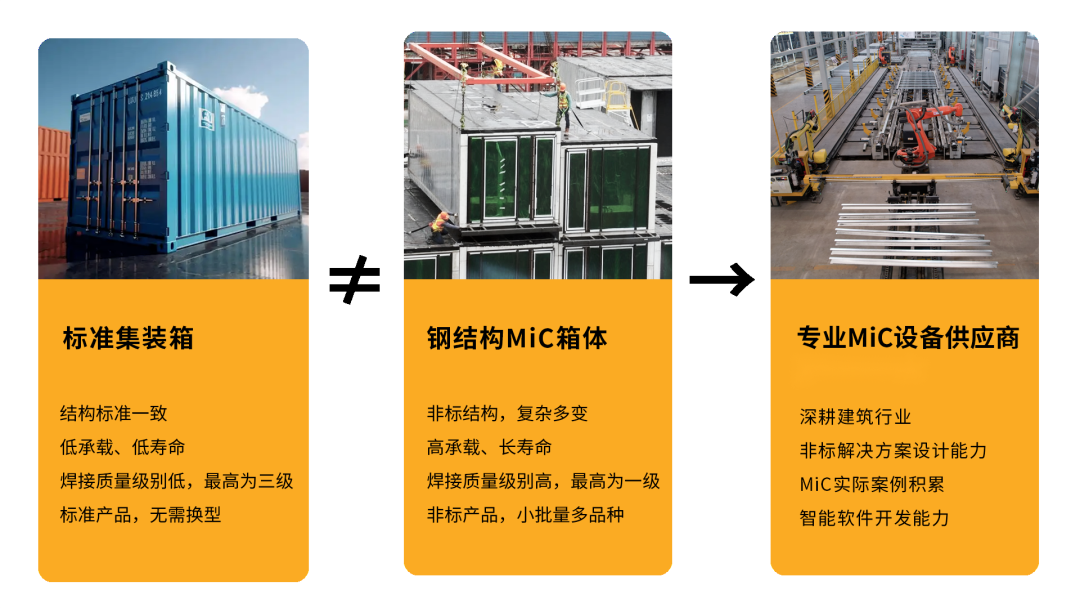
As the core load-bearing structure of MiC buildings, the manufacturing precision and efficiency of frame module units directly impact construction quality and speed. To address this, CNGBS has built a highly coordinated "welding robot team" for its partner enterprises. By scientifically planning production line layouts and material flow, it ensures production continuity, reduces material handling and waiting time, significantly improves production takt time, and boosts changeover efficiency by 150%.
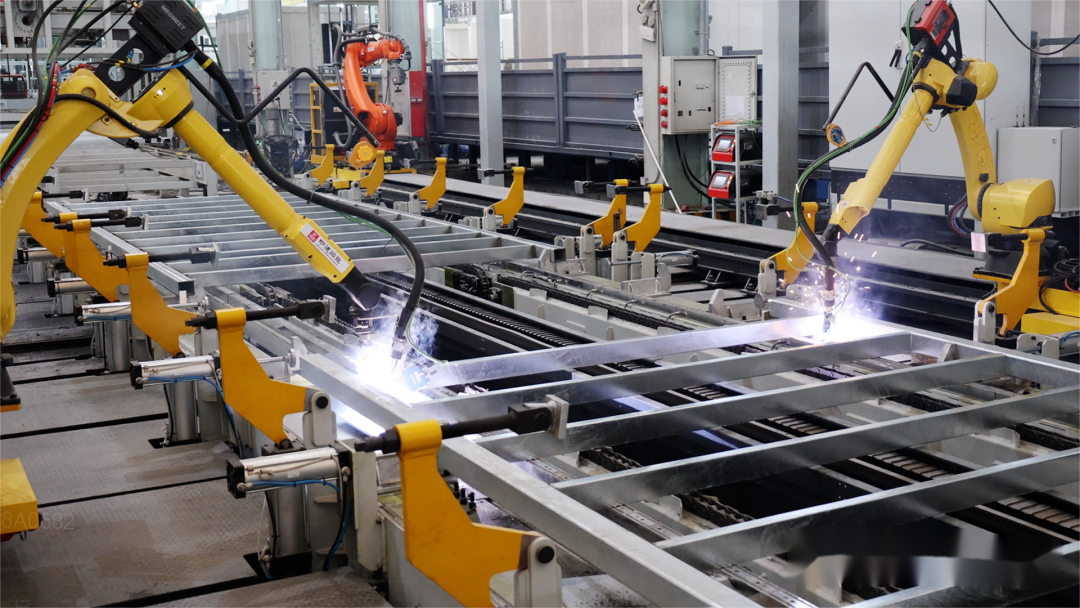
In the top and bottom frame assembly, welding, and grinding production line, handling robots precisely feed secondary beams into the station. After the assembly table automatically clamps and positions them, two welding robots immediately initiate automatic scanning and welding. Upon completion, modules are automatically transferred to the grinding station for zinc removal grinding on the main beams, laying the foundation for the subsequent top plate welding process. This production line is easy to operate, offers high assembly precision, and is compatible with workpieces ranging from 2.5 to 4.5 meters in width and 2 to 14 meters in length, achieving a stable production capacity of one set every 30 minutes.
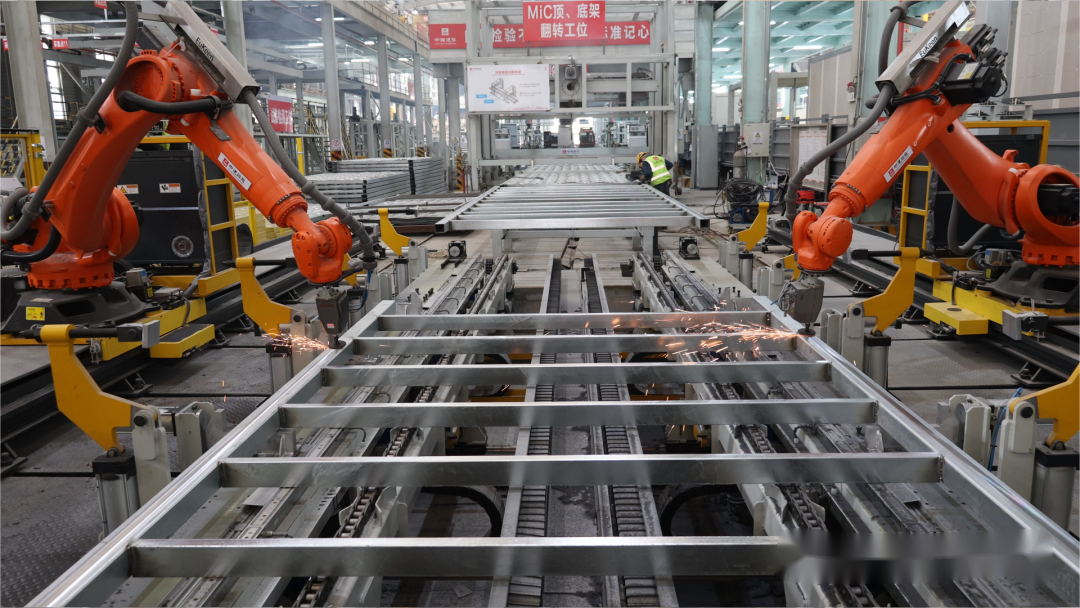
After the top and bottom frames are produced, modules move to the top plate welding station, where two welding robots utilize real-time seam tracking technology to ensure the quality and stability of every weld.
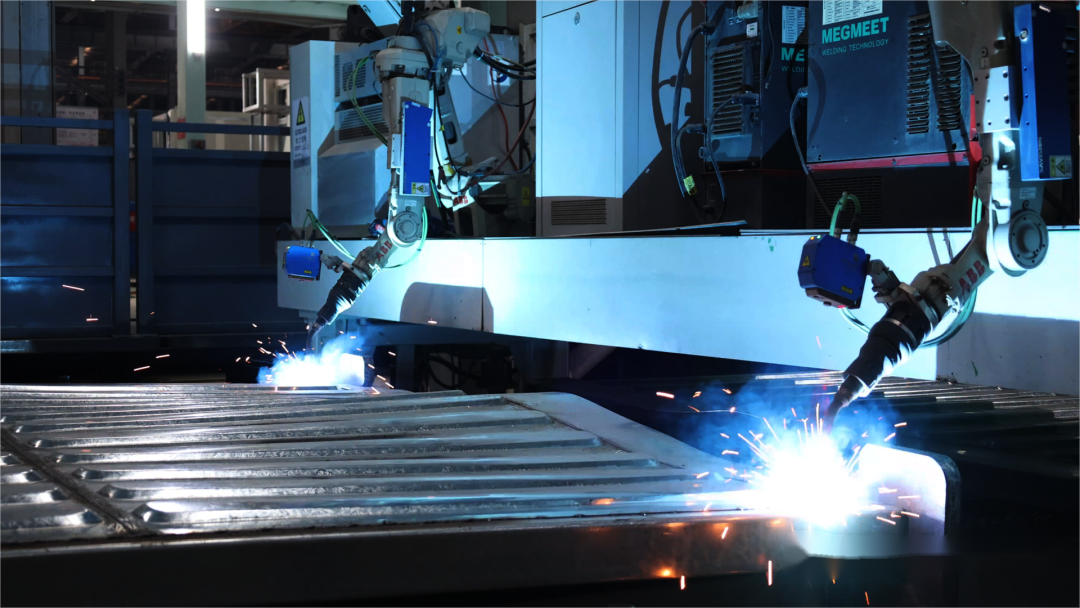
The end frame column assembly and welding production line achieves full-process automation: an automatic loading/unloading system precisely feeds materials, and two welding robots scan, locate, and weld the components at both ends of the column. This system can easily handle full penetration welding requirements for materials with wall thicknesses of 10-16mm. Paired with flexible tooling and a C-type positioner, it adapts to workpieces ranging from 2.6 to 4 meters in length, achieving a production capacity of one column every 30 minutes.
The key to the efficient coordination of this "welding robot team" lies in the support of the CNGBS modular teaching-free welding software – the "intelligent brain" – which enables a qualitative leap in production processes and efficiency.
There's no need for workers to spend significant time marking up drawing information. By simply importing 2D or 3D drawing models (dwg/ifc) into the software, the system can quickly interpret the drawing content, automatically extract key information such as component dimensions and weld seam locations, and precisely plan robot actions, directly saving over 80% of programming time.
The software incorporates rich built-in libraries of welding and grinding process parameters, ensuring consistent and stable quality standards for every production run. Simultaneously, through robot simulation functions, it pre-simulates the production process, effectively preventing collision risks during processing and reducing production costs.
When faced with different project requirements and product types, the software can flexibly "command" the production line to adapt and adjust, achieving true flexible production. This helps enterprises respond quickly to market customization orders and maintain a competitive edge. Furthermore, the software reserves standardized interfaces for future seamless integration with enterprise MOM systems and production management systems, facilitating efficient data integration, enhancing production management transparency and response speed, and promoting the implementation of refined management.
The successful advancement of this modular project highlights CNGBS's accumulated capabilities in six core areas: order response, production line development, production line construction, production line validation, operation and maintenance services, and continuous innovation. It also represents a comprehensive test of the enterprise's overall competitiveness.
As a reliable partner in the non-standard industry, CNGBS possesses deep insights into the unique challenges and demands of modular building production. By creating flexible and customizable welding robot production line solutions, it breaks through the numerous barriers of non-standard production, satisfying the personalized production needs of the MiC industry.