
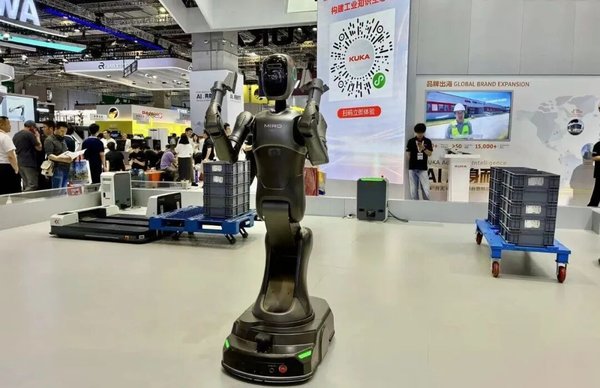
The 26th China International Industry Fair opened in Shanghai on October 12, covering an exhibition area of 310,000 square meters and attracting over 3,200 exhibitors. The most noticeable change in this year's robotics exhibition area is that there are fewer robots dancing and doing somersaults, and more robots working on production lines. Wheeled robots: Finding "workstations" in the factory Wheeled dual-arm robots were the most densely represented category at this year's expo. The Metob ot G2 "went to work" directly on the exhibition stand, performing precise loading and unloading of the metal housings for automotive seat belt retractors on the JUMP intelligent production line. When handling reflective metal parts, the cycle time for a single operation was kept within 13 seconds, with a consistent success rate of over 99.9%. At Longcheer Technology's Nanchang factory, the Elf G2 completed integration and line merging in 36 hours, processing approximately 3,000 units per shift.
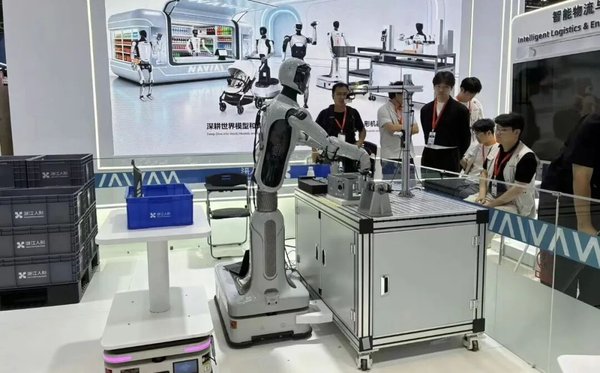
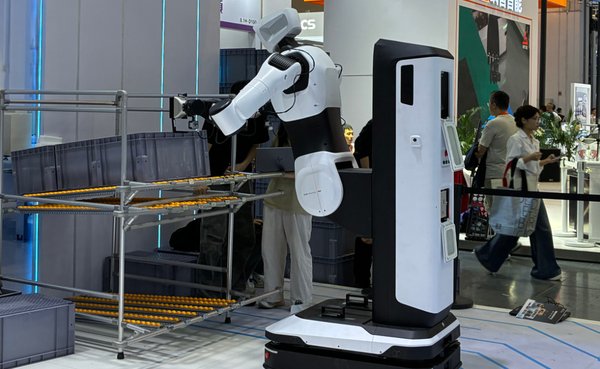
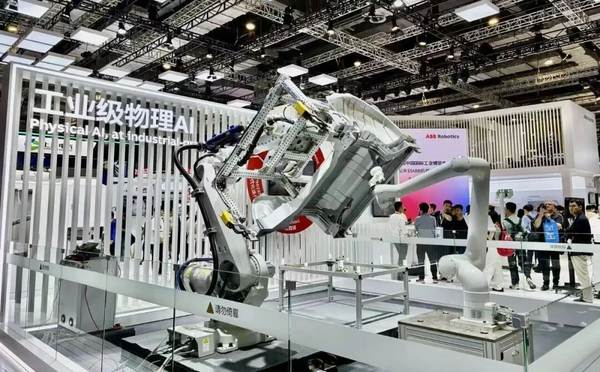
Leju's Kuafu 5W continuously performs carton destacking, small parts loading, and multi-specification bin handling operations on the simulated production line. The solutions demonstrated on-site are ready for delivery. The robots can operate stably for 8 to 10 hours per day, and the relevant solutions have been adopted by more than a dozen industry clients, including FAW, Hisense, and China Logistics. The forms are similar, but the scenarios are different. The common goal of these demonstrations is not to pursue "human-likeness," but to first address the question of "whether it can be integrated into existing production lines to perform tasks." ABB's "Physical AI": Teaching Old Robots New Skills ABB showcased a different approach: instead of building new bodies, it enables existing industrial robots to acquire perception and learning capabilities.
In the live pour-over coffee demonstration, the GoFa collaborative robot replicates the water flow trajectory and pre-infusion rhythm through imitation learning, relying on its understanding of time and water flow rather than fixed coordinate control. "The next era of industrial automation will be defined by the speed at which robots learn, not by their programming capabilities," said Marc Wälle, Global President of ABB Robotics. The accompanying RobotStudio HyperReality can generate synthetic data with an accuracy of up to 99%, helping manufacturers complete virtual validation before production. OmniCore EyeMotion integrates AI vision, reducing the vision deployment cycle from months to days.
A question that is openly discussed: Where does the data come from? During the opening roundtable discussion, Wang Jian, an academician of the Chinese Academy of Engineering, made a very straightforward statement: Industrial data is "locked in everyone's drawers." He called on manufacturing companies to make their data available to robotics companies. Wang Xingxing's response was equally straightforward: "AI needs all the data."However, he also acknowledged the practical difficulties: many companies have confidentiality requirements. The value of this discussion lies not in what anyone agreed to, but in the fact that it openly exposed a structural contradiction: robotics companies need real production line data to train their models, but the manufacturing companies that hold the data are constrained by trade secrets and security concerns.
Optimism and restraint coexist. Wang Xingxing made a widely quoted statement at the China International Industry Fair: "The biggest mistake I've made over the past decade or so is not believing in AI enough."He believes that the tipping point for embodied intelligence will arrive within one to two years at the earliest, and that next year, GPT-7 "may directly break through the problem." However, he also offered a measured assessment: The large-scale deployment of robots in factories still faces challenges related to generalization capabilities and efficiency, and progress in implementing them in commercial service settings may outpace that in industrial environments. The requirements for reliability and yield in industrial settings are precisely what embodied intelligence currently finds most challenging to meet. The demonstrations at the booth prove that it "can be done," but what factories need is for it to be "consistently done." From the perspective of the CIIF, the direction for the integration of embodied intelligence into factories is clear, but it is still some way off from being implemented on a "large scale."


Chat on WeChat
 WeChat: +86 189 6455 1752